
Contact us / appointments
Here are some useful links and information about genital health and how to spot symptoms when something is wrong.
Balanitis - NHS (when the head of the penis is swollen and sore)
Thrush in men and women - NHS (a common infection among both men and women)
Cervical screening - NHS (helping to prevent cervical cancer)
What is testicular cancer?
Cancer of the testicles, also known as testicular cancer, is one of the less common cancers. It usually affects younger men between the ages of 15 and 49.
Testicular cancer occurs when normal, healthy cells, which are carefully regulated by the body, begin to reproduce uncontrollably within an area of the body such as the testicles.
- More than 2,200 men will be diagnosed with testicular cancer in the UK each year.
- More than 21,000 men will be diagnosed in Europe each year and around 55,000 globally.
- It most commonly affects men between the ages of 15-49 and is statistically the most common cancer in men aged between 25-49 in the UK (Cancer Research UK).
- Around 47% of men diagnosed will be under the age of 35.
- 98% of men will live for years after treatment.
- Around 60 young men may die of testicular cancer each year.
Causes of testicular cancer
The cause or causes of testicular cancer are unknown, but a number of things have been identified that increase the chance of developing the condition. These include:
- having a family history of testicular cancer. Men with a brother or father who’ve had testicular cancer are slightly more at risk of getting it - although the risk is still small. Some research has indicated that there may be direct genetic factors involved in this process.
- being born with undescended testicles (cryptorchidism). The testicles of a male baby form in its abdomen while in the mother’s womb and normally descend into the scrotum at birth or shortly afterwards. Around 10% of men diagnosed with testicular cancer may have a history of this condition. Although it can be corrected using a minor surgical technique during childhood (an operation called an orchidopexy) the risk of developing testicular cancer still remains greater.
- pre-cancerous cells found inside the testicle known as carcinoma in situ (CIS). They may be found when a man has a testicular biopsy for instance during investigations into infertility. This is also referred to as intratubular germ cell neoplasia (IGCN). There is a 50% chance that these cells will develop into testicular cancer within five years.
Testicular self-examination
The testicular self-examination, or (TSE), is a quick, simple, painless, exam that you can perform on yourself in the privacy of your own home.
All guys should perform the TSE once a month from the time they are 15 years old.
Steps to the monthly testicular self-exam
- Check yourself after a bath or a shower.
- Stand in front of a mirror. Support your testicles with one hand and feel (examine) each one with your other hand.
- Roll your testicles between your index finger and thumb, feeling around for any lumps or bumps, hardened areas.
What to look out for
- A lump – pea-shaped, round shaped or may even feel like a piece of rice.
- Swelling in a testicle, which is usually painless – occasionally the swelling may suddenly increase in size and become painful.
- Pain or heaviness in the scrotum.
Lumps and bumps on the testicles may be other things, but you still must get this checked out.
Orchid cancer has produced a leaflet to help raise awareness of testicular health with step-by-step instructions on how to perform a testicular self-examination.
To help your genital skin become healthier:
Do use an emollient (except soft white paraffin alone) to wash your genitals.
Do wear cotton underwear, but nothing too tight at night (ideally nothing at all).
Do choose non-scented, non-perfumed lubricants.
Do shower rather than bathe if possible – in a bath you are sitting in all the bath products. If you want a bath, use lukewarm water, wash your skin with an emollient only, wash your hair at the end of the bath and rinse off your genitals with water and emollient. Limit baths to ‘treat’ time only.
Don’t wash your genitals with foaming products – no soaps, shower gels or bubble bath products.
Don’t apply perfumed products to your genitals – no baby wipes, feminine washes, douches, perfumed toilet tissues, sprays or perfumed lubricants.
Don’t wash too much – it irritates the genital skin. Just use your hands to wash the genital area.
Don’t have the water too hot as it dries the skin out – try to have lukewarm showers.
Don’t rub the skin dry, pat it dry with a towel instead.
What are emollients?
Emollients are skin friendly moisturisers which are recommended for skin conditions. They soothe and protect the skin, helping to reduce itchiness, soreness and irritation. The emollients featured below are available on prescription from your GP, but can also be bought over the counter and from online pharmacies without a prescription.
Types of emollients
Different products suit different people and you may need to try a few before finding one that suits you.
Soap substitutes
Emollients can be used to wash with instead of soap or shower gels. They do not foam so may take a little while to get used to but they effectively clean the skin without drying it out.
- Dermol® cream or lotion
- Hydromol® ointment
- Hydromol® Bath & Shower 2
Ointments
Ointments hold water in the skin and repair its protective barrier. They contain fewer preservatives and are useful for very dry skin. They can be applied every six to eight hours. Ointments should not be used for weeping eczema. They are thick and greasy and some people find them easier to apply at bedtime rather than during the day.
- Diprobase® ointment
- Hydromol® ointment
- Zeroderm® ointment
- Cetraben® ointment
- Epimax® ointment
- Epaderm® ointment (contains preservative
- Emolin® spray
Creams
Creams feel light and cool on the skin, they are relatively easy to spread over sore and weeping skin and are non-greasy. Many people prefer them to ointment, particularly for daytime use. Creams contain preservatives which can cause sensitivity in some people. They should be used liberally and applied frequently (every three to four hours) to effectively repair the skin barrier and stop it drying out.
- Cetraben® cream
- Hydromol® cream
- Epaderm® cream
- Diprobase® cream
- Dermol® cream (anti-microbial)
- Doublebase® gel
Any there any precautions I need to take when using emollients?
There have been reports that paraffin-based emollients, regardless of paraffin concentration, have been associated with severe and fatal burns. Tests have also highlighted that other paraffin-free products can have a fire accelerant effect. The emollient products are not flammable themselves but can act as an accelerant, increasing the speed of ignition and intensity of the fire when fabric with residue dried on it is ignited.
When using emollients you should:
- not smoke or go near naked flames because clothing or other fabrics such as bedding that have been in contact with an emollient or emollient-treated skin can rapidly ignite
- be aware that washing clothing or fabric at a high temperature may reduce emollient build-up but not totally remove it.
Anal cancer and anal "pre-cancer" (also known as anal intra-epithelial neoplasia or AIN) are increasingly common amongst individuals living with HIV, even when they are on effective treatment.
These cancers are mostly caused by a virus - the Human Papilloma Virus (HPV), which is more common in those living with HIV.
It is therefore recommended that you should self-check your anal area (bum hole) and rectum (bottom) at least once a year. This information will explain how you can do this.
What are the symptoms I need to be aware of?
Symptoms include bleeding, itching, lumps (warts or similar), or sores around the anus, discharge or bleeding from the back passage, pain or pressure (like the feeling that you need to poo) in the rectum.
If you notice any of these, tell your HIV doctor or your GP.
How do I examine myself?
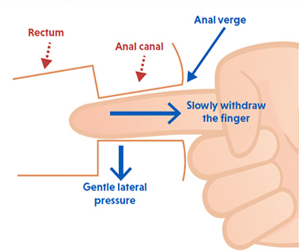
Make sure you have short fingernails before you start.
In the shower... You can feel more this way:
- While you are in the shower, gently insert your index finger inside your bottom.
- Slowly and gently rotate your finger around checking for any lumps, bumps or sores.
- Lubrication on your finger can help.
- You can use exam gloves if you prefer.
- Wash your hands after.
On the floor... You can see more this way:
- You will need a mirror and good lighting.
- Sit down with your knees up and the mirror between your thighs.
- Lay back slightly so you can see your anus (bum hole).
- Check around the outside of the anus for any lumps or sores and then with your fingers push the bum hole open to look for any bleeding or lumps.
- Wash your hands after.
Is there anything else I can do to reduce my risk of anal cancer?
- TELL YOUR DOCTOR if you're worried about any symptoms you have noticed or found. We are used to hearing about "private parts" - don't die of embarrassment.
- USE CONDOMS: Using condoms for sex will reduce the risk of acquiring HPV.
- STOP SMOKING: Smoking increases your risk of developing genital cancer. Cut down - or best of all QUIT! Speak to one of the HIV clinical team or contact www.livewelldorset.co.uk, Freephone 0800 840 1628 for support.
- GET VACCINATED: The HPV vaccine protects against infection with certain types of HPV. Talk to one of the HIV team about this.
What happens if I am found to have anything suspicious?
The HIV teams in Dorset have developed a pathway with a specialist team at the Royal Bournemouth Hospital, who have expertise in managing AIN and anal cancers.
All patients with suspected AIN or anal cancer will be referred for monitoring and treatment. In the future, if it is shown to be of benefit, screening similar to the cervical cancer screening programme may be possible.
References
European AIDS Clinical Society (EACS) guidelines 2023 p 64. Prevention and management of co-morbidities. Cancer: Screening methods https://
2008 UK National guidelines for the management of the sexual and reproductive health of people living with HIV
https://